Introduction
You opened a fresh RELX pod three days ago. The tobacco flavor that once had a clean, sharp edge now tastes like warm air. Nothing changed: same device, same charging routine, same pod flavor you have been using for weeks. So what happened?
Almost certainly, nothing is wrong with the hardware. The problem is in your sensory system, not your device. What you are experiencing is called vape flavor fatigue, and it affects every pod and heated tobacco user eventually, whether you use JUUL, RELX, or IQOS ILUMA with TEREA sticks.
This guide explains why it happens at a biological level, why pod users and heated tobacco users experience it differently, and what to do about it depending on the device you use.
Quick Answer
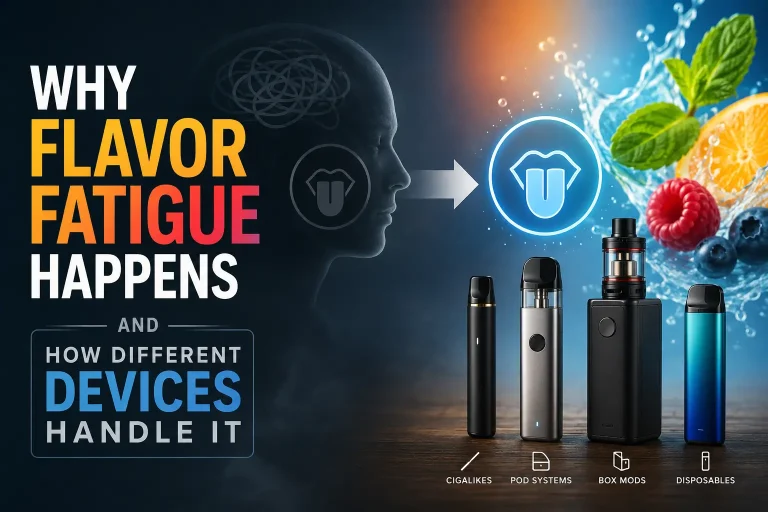
Vape flavor fatigue is the temporary loss of flavor intensity caused by olfactory receptor adaptation, your nose becoming desensitized to the same aroma molecules through repeated exposure. It is not a hardware fault. It resolves with rest, hydration, or a flavor change, typically within a few hours to 3 days.
Quick Fixes by Device Type
| Fix | Pod Users (JUUL / RELX) | HTP Users (TEREA) |
|---|---|---|
| Hydrate consistently throughout the day | Yes | Yes |
| Take a 30–60 minute device break | Yes | Yes |
| Smell coffee beans or fresh citrus peel (a common palate-cleansing technique) | Yes | Yes |
| Switch to a contrasting flavor family (palate reset) | Yes | Yes |
| Replace pod or refresh to a new one | Yes | Not applicable |
| Activate Pearl capsule mid-session (intra-session aroma contrast) | Not applicable | Yes Pearl variants only |
| Use a humidifier (supports nasal passage moisture) | Yes | Yes |
| 24-hour full device break most reliable long-term fix | Yes | Yes |
If flavor loss persists beyond 7 to 10 days despite rotation, breaks, and hydration, the cause is likely illness (nasal congestion or sinus infection) rather than sensory adaptation. Consult a pharmacist.
TEREA Flavor Rotation Strategy (UAE Users)
Rotate TEREA flavor families every 3 days. Use a rich or balanced tobacco variant as your primary, then switch to a menthol or pearl variant as a palate-reset anchor. The contrasting volatile compound profile in menthol breaks olfactory receptor adaptation faster than any other TEREA family.
| Days | Recommended Variant Type | TEREA Examples | Purpose |
|---|---|---|---|
| Mon – Wed | Rich or Balanced Tobacco | Amber, Sienna, Teak, Yellow | Daily baseline your primary tobacco flavor |
| Thu – Fri | Menthol or Pearl variant (palate reset) | Shine Pearl, Starling Pearl, Black Menthol, Turquoise | Contrasting aroma molecules disrupt receptor adaptation |
| Weekend | Aromatic or alternate tobacco | Provence Pearl, Purple Wave, Green | Additional variety prevents flavor fatigue building on primary |
The 3-Day Rule: Olfactory adaptation to a specific aroma profile can begin within 72 hours of continuous identical exposure. If you have used the same TEREA variant for three consecutive days and flavor feels thinner, the rotation is overdue.
The Science Behind It: Why Your Brain Stops Tasting
Olfactory Adaptation: The Core Mechanism
Your sense of taste is far more dependent on your sense of smell than most people realize. Smell accounts for approximately 70% of perceived flavor; the tongue handles basic signals like sweet, salty, or bitter, but the richness, identity, and depth of a flavor come from olfactory receptors in the nasal passage.
These receptors work by detecting specific aroma molecules. When they encounter the same molecules repeatedly over a short period, they begin to adapt, temporarily reducing the strength of the signal sent to the brain. This is the same mechanism that makes a strong smell in a room unnoticeable after ten minutes. Your brain is not ignoring the signal out of preference; it is actively dampening a continuous, unchanged input to preserve neural processing capacity for new stimuli.
The result in vaping: a flavor that once hit hard now registers as flat or thin.
Olfactory Fatigue vs. Gustatory Fatigue: Not the Same Thing
The term “vaper’s tongue” is technically a misnomer that has become industry shorthand. True gustatory fatigue (taste bud desensitization) does occur, but taste buds regenerate on a cycle of roughly 10 days and are rarely the first point of failure. Olfactory receptors in the nasal passage adapt much faster under continuous identical exposure.
The distinction matters because the fix is different. Taste bud fatigue resolves with time and reduced consumption. Olfactory fatigue resolves faster with flavor contrast, exposing receptors to a sharply different aroma profile and breaking the adaptation loop. This is why switching flavor profiles restores sensitivity within minutes rather than days.
Dehydration as a Multiplier
The core ingredients in e-liquid, propylene glycol (PG) and vegetable glycerin (VG), are hygroscopic; they actively draw moisture from the surrounding environment, including the mouth and nasal cavity. Reduced saliva is not just uncomfortable; saliva is the transport medium that carries flavor molecules to taste receptor sites. Without adequate saliva, even a functioning sensory system cannot register flavor normally.
This dehydration effect is relevant to all pod device users, though the mechanism differs for heated tobacco users who inhale aerosol rather than e-liquid vapor, covered in the TEREA section below.
How Pod Systems Like JUUL and RELX Accelerate Flavor Fatigue
The Closed System Problem: Flavor Lock
Both JUUL and RELX are closed-system pod devices. You cannot refill them with an arbitrary e-liquid; you use the manufacturer’s pods in their available SKUs. In the UAE, JUUL’s available range is tightly limited to Virginia Tobacco, Mint, and Menthol. RELX offers a wider range, but the pod format still constrains how many flavor profiles are realistically in daily rotation.
This structural limitation forces repetition. When a user sticks to one or two pod flavors across consecutive days, olfactory receptors are hit with the same aroma molecules in every session, every hour. The adaptation response triggers faster than it would with a rotating multi-flavor setup.
There is a secondary factor specific to JUUL: nicotine salt concentration. JUUL pods operate at approximately 50 mg/mL nicotine salt, one of the highest concentrations in the pod category. At this level, nicotine’s natural alkaline-bitter properties act as a flavor suppressor, masking the subtler aromatic notes in the e-liquid formulation. As a pod ages and flavor compounds naturally oxidize, users notice flavor loss earlier on JUUL than on lower-nicotine alternatives because the nicotine baseline was already muting the top notes from the start.
RELX Flavor Fade: Hardware and Biology Combined
RELX device users often report a specific pattern: a pod tastes excellent for the first day or two after the seal is broken, then noticeably softens by day three or four. This is not just sensory adaptation. RELX acknowledges that flavor begins to soften approximately 72 hours after the pod seal is broken, as e-liquid oxidation interacts with the FEELM ceramic coil. Oxidized e-liquid produces a flatter flavor profile regardless of receptor sensitivity.
A second mechanism compounds this: overuse saturation. The FEELM ceramic coil is highly consistent under normal use, but during heavy or chain-vaping sessions, the wick cannot re-saturate fast enough. The result is a temporary lean condition where vapor is produced, but flavor is thin, often mistaken for a dead pod when the pod is actually fine.
The combined effect of oxidation softening, wick saturation lag, and olfactory adaptation means RELX users frequently hit flavor fatigue by mid-pod rather than end-of-pod. Swapping to a new pod of the same flavor only partially resolves it, because the sensory component remains.
Chain Vaping and Pod Convenience
The portability and low-friction design of pod systems drive a higher natural puff frequency than cigarettes or heated-tobacco sessions. There is no defined endpoint to a pod session, unlike a cigarette that burns down or a TEREA stick that signals completion through haptic feedback after 14 puffs.
Short, rapid inhales compound olfactory desensitization faster than session-style use with natural pauses. In Dubai and the UAE, where users spend extended time indoors in controlled air-conditioned environments, the typical outdoor olfactory reset variable (fresh air, ambient scent variation) is reduced. This removes one passive mechanism that helps refresh receptor sensitivity throughout the day.
Why Heated Tobacco Users Experience Flavor Fatigue Differently
A Different Mechanism from the Ground Up
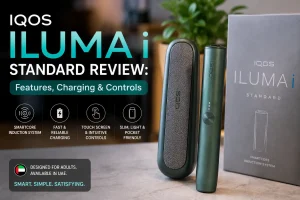
The IQOS ILUMA with TEREA sticks operates on a fundamentally different delivery mechanism than pod systems. There is no e-liquid, no wick, no coil. The flavor source is a real tobacco matrix heated from within by IQOS’s SmartCore Induction System at a controlled temperature below the combustion point. This eliminates three common causes of pod-device flavor degradation: coil degradation, wick burn, and e-liquid oxidation after seal break.
What remains is the biological component: olfactory adaptation to the tobacco aerosol profile. The mechanism still exists, but its triggers and timeline are different.
Why Flavor Fatigue Onset Is Slower for TEREA Users
Two structural factors delay adaptation for heated tobacco users compared to pod users:
- Natural tobacco complexity. Real tobacco contains hundreds of distinct volatile aromatic compounds. A typical pod e-liquid contains between 3 and 6 active flavor molecules. More chemical diversity means olfactory receptors encounter a broader range of signals per session, slowing uniform adaptation to any single compound. This aromatic complexity also explains why some TEREA variants feel richer than others even when nicotine strength is identical across the range.
- Session-style use with a defined endpoint. Each TEREA stick delivers approximately 14 puffs, then the session ends. Fewer concentrated olfactory hits per hour means slower cumulative desensitization.
Additionally, Pearl variants include a flavored capsule that delivers an intra-session aroma contrast, a menthol or fruit-menthol burst that interrupts the continuous tobacco signal. This is a structural advantage standard tobacco TEREA variants lack.
The Tobacco Palate Adaptation Problem
Long-term TEREA users who have been on the same variant for 12 months or more often report a gradual dulling of the tobacco base notes that is distinct from the acute flavor fatigue experienced by new users.
There are two contributing mechanisms. First, standard olfactory adaptation to the specific volatile profile of a familiar TEREA variant builds cumulatively over months, even with reasonable variety. Second, many TEREA users are former cigarette smokers whose taste receptors were damaged by years of combustion exposure. In the early months of switching, the perception of TEREA flavor is partly amplified by contrast with the dulled sensory state caused by cigarettes. As receptor damage heals and baseline sensitivity improves, the initial effect normalizes, not because TEREA got weaker but because the sensory baseline shifted upward.
For users who have recently made the switch, our guide to the best TEREA starting flavors for former cigarette smokers covers which variants deliver the most satisfying flavor during that adjustment period.
This is not a sign of product failure. It is a sign that your sensory system is recovering. The practical response is the TEREA rotation strategy outlined above.
Dehydration in Heated Tobacco: A Lower but Real Factor
TEREA aerosol contains significantly less PG and VG than e-liquid vapor. The dehydrating effect on the mouth and nasal passage is present but lower in magnitude than in pod system use. For TEREA users, flavor rotation strategies are a more effective primary intervention than hydration alone, unlike pod users, where both are approximately equally impactful.
Flavor Fatigue Is Temporary: Here Is What to Do Next
Vape flavor fatigue is not a device problem, and it is not permanent. The fix is the same at its core, give your olfactory receptors a contrasting signal and time to reset. Pod users have the fixes table above. TEREA users have the rotation framework. Start there, and in most cases flavor comes back within hours.
If you’re deciding which TEREA variants to include in your rotation, Vape Hype is a great place to start, with a wide selection of TEREA flavors and editions available.
Frequently Asked Questions
What is the difference between vape flavor fatigue and vaper’s tongue?
They are the same thing. “Vape flavor fatigue” is the more accurate term because the issue is usually smell adaptation, not the tongue itself.
How long does vape flavor fatigue last?
Most cases improve within a few hours to 24 hours with hydration, flavor rotation, or a short break. Without intervention, it usually resolves within 2–3 days.
Does JUUL cause more flavor fatigue than other pod devices?
It can. JUUL’s limited flavor options and high nicotine strength may make flavor fatigue noticeable sooner for some users.
Why does my TEREA taste weaker than when I first started using it?
Regular use can lead to flavor adaptation over time. Rotating TEREA variants is often the most effective way to restore flavor perception.
Does RELX flavor fading mean my pod is empty or broken?
Not always. Flavor can weaken due to e-liquid oxidation and sensory adaptation even when the pod is still functioning normally. Can you permanently lose taste from vaping? There is no evidence that vape flavor fatigue causes permanent taste loss. If taste or smell loss lasts more than 10 days, consult a healthcare professional.